
Welcome to Delhi
by Mark Henry Bloom, Copyright 2025
This is a story about India in 1987. Its tourist industry revolved around hippies looking for cheap weed and 5-star hotel patrons who stayed safely behind sheets of glass while viewing the country. I fell somewhere in the middle. Having traveled around Europe on a low-budget and a non-existent itinerary, I figured I was perfectly capable of navigating India without the aid of a tour company. I booked my own flight and flew to Delhi on a Saturday night in December. I arrived on Sunday morning, tired but ready to see the town. That’s when I realized my first mistake.
India back then had a closed economy. Because of currency controls in effect at the time, it was impossible to obtain rupees outside the country, and tourists with rupees on their person needed proof that the money was obtained from a bank. Breaking this law was punishable by jail time.
But here it was Sunday morning and the banks were closed. I had two options: do without money all day, which included sleeping on the street, or change money illegally. I decided to change some dollars into rupees. I found a very willing taxi driver, who tore down the headliner and tore up the carpets of the cab to find the right denominations. Feeling somewhat vulnerable after having committed a crime within 20 minutes of landing in a country where I had no desire to sample the correctional institutions, I asked the cab driver to take me to the modest hotel I’d selected from a guidebook.
Within five minutes, though, we were stopped by the police. Shit! I felt the illegal money glowing red in my pocket. But the cop seemed only mildly interested in me. Instead, he had a heated conversation with the cab driver who eventually doled out what I assumed was a standard bribe, called a baksheesh, and we were sent on our way.
When we approached the hotel, it became clear that the driver had strayed from my instructions, and we were at a different hotel. When I politely pointed this out, he vehemently argued that his choice was much better, then pleaded with me just to take a look—if I didn’t like it, he promised to take me to where I’d asked to go. So I agreed.
The hotel seemed OK, but I wanted a place that had a ring of legitimacy, so I decided to stick with my original choice. When I got back to the curb, though, my bag was unloaded and the cab was gone. If you’ve traveled in Third World countries, you’re aware of the collusion that goes on between hotel owners and cab drivers to attract patrons. I’d been neatly delivered to a paying hotel owner.
So let’s recap. I’d been in India a little under an hour and broken the law, witnessed police corruption, and been kidnapped. Great start. I took a room at the unchosen hotel and decided to explore. Walking in downtown Delhi wasn’t exactly relaxing, as the traffic felt like I was constantly within inches of being run over.
Jet lag eventually caught up with me, so I returned to the hotel, looking for an early dinner and sleep. After a quick meal in the hotel restaurant, I retired to my room. As I closed the door, I noticed that the three former locks had been ripped out of the wood, leaving precisely none left. I went to sleep that night with all my documents and money stuffed in the pillowcase under my head, secretly convinced I would not wake up alive.
India’s since become one of my favorite countries. At the time, however, I was reasonably convinced I would never make it out alive.
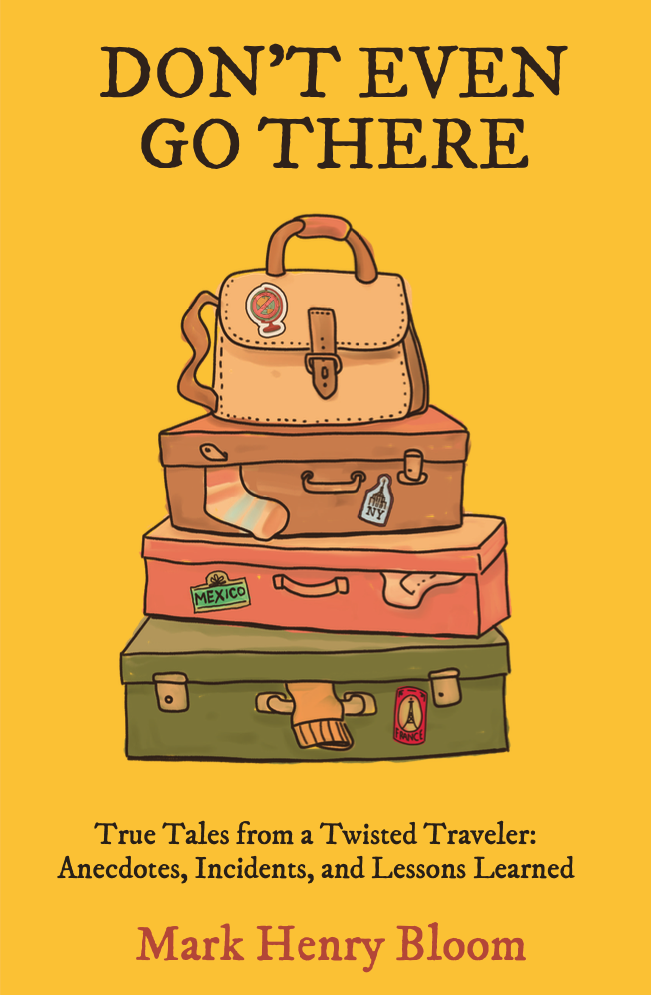
This is an early version of the story Delhi for Dummies, as published in Don’t Even Go There, in the section Shattered Dreams, which is about the illusions of a destination, compared to the reality.