
From Soup to Gnats
by Mark Henry Bloom, Copyright 2025
You can find timeshares all over the world—anywhere there’s an island, a mountain, a golf course, a lake, or just a historical plaque. If you’re the type to go backpacking through Ireland, trekking in Nepal, or kayaking down the Royal Gorge, you won’t find a timeshare where you need one. But if you love the resort life—riding the waves or skiing the slopes—timeshares might be a fun alternative for you.
Timeshare units offer amenities hotels don’t: a kitchenette, a pull-out sofa, even laundry facilities. For the right person, a timeshare can be a good vacation investment. That’s the rub. If the phrase “vacation investment” appeals to you, I have a timeshare to sell you.
Most timeshares are pristine. If cleanliness is next to godliness, timeshares are the holy Mecca of recycled lodging. But like all blanket assertions, there are exceptions. Welcome to my world. Here’s the story…
Everything looked promising when I arrived with some friends. The timeshare I’d reserved online, built sometime in the 1970s, seemed well groomed from the outside. Several golf courses and other amenities lay nearby.
The next day, the women left us men to fend for ourselves to attend to some serious sunbathing and shopping. We enjoyed our freedom until noon, when a potential life-threatening issue confronted us. Could two cave-dwelling Neanderthals like us manage lunch without a grill?
The timeshare had a working kitchenette. A quick trip to the grocery store could have provided anything we needed, but like many American men, we grilled when we cooked. Without a grill, our cooking skills devolved into reheating, boiling, and toasting.
We eventually decided on soup, an easy meal that required only heating. But who wants to eat soup on a hot summer day? So we did what any intelligent person would do: we cranked up the air conditioning. Hey, we had to eat. After lunch, we played a round of golf to warm back up. Hey, it was a vacation.
This became a daily routine. During the following days, I spent time with my favorite authors and consumed hours of TV. Eventually, I successfully decompressed from my hard-scrapple life as a self-unemployed writer.
What happened next became apparent gradually, like syrup leaking onto a refrigerator shelf. You don’t notice it for days, but when you do, it’s too late. We discovered hundreds of tiny insect bites on our legs. At first, we thought we were the victims of bedbugs, but the women were completely unscathed—and totally unsympathetic. I eventually tracked the problem to the couch, where I’d spent most mornings.
The couch, it turned out, was a breeding ground for gnats, a self-serve restaurant for no-see-ums. They crept onto our skin and had their way with our flesh. Apparently, the air-conditioned cold from our lunchtime meals forced them to seek warmth more vigorously than usual.
The timeshare management offered to asphyxiate us with pesticides, but we refused; we’d rather be bitten than poisoned. So we did the only thing that made any sense: we invited more friends for the weekend. “Sure, you can sleep on the pull-out couch.”
Lessons Learned: Timeshares aren’t meant to be kept to yourself. That’s why the sofa expands into a bed … to share the love.
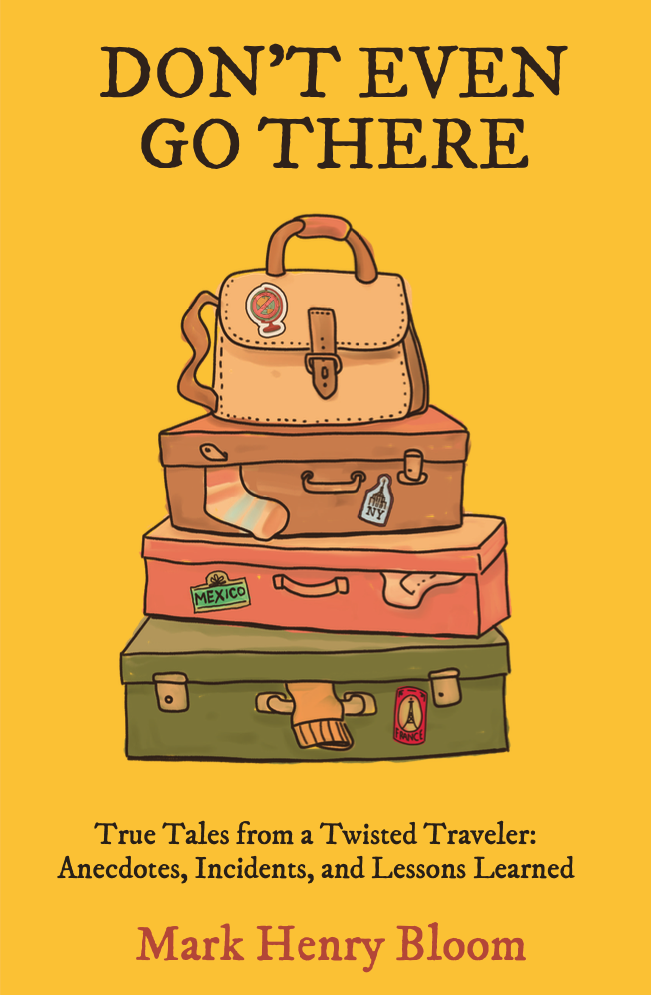
This is a travel story that would have gone into the Cherry Pits section of the book, a section that’s about areas to avoid in otherwise popular places. Read much better stories in the published version of Don’t Even Go There.